
Why Pool Fee Percentages Are Not Comparable at Face Value
Two percentage points of fee difference is worth about $2.42 a month at 100 TH/s and roughly $242.33 a month at 10,000 TH/s, because a percentage is charged on output rather than on a fixed sum. So a quoted rate tells you nothing about cost until you know the base it lands on, the component it attaches to, and when it is settled.

Key takeaways
- Normalize on output first: the same two points of rate are $2.42 a month at 100 TH/s and about $242.33 a month at 10,000 TH/s.
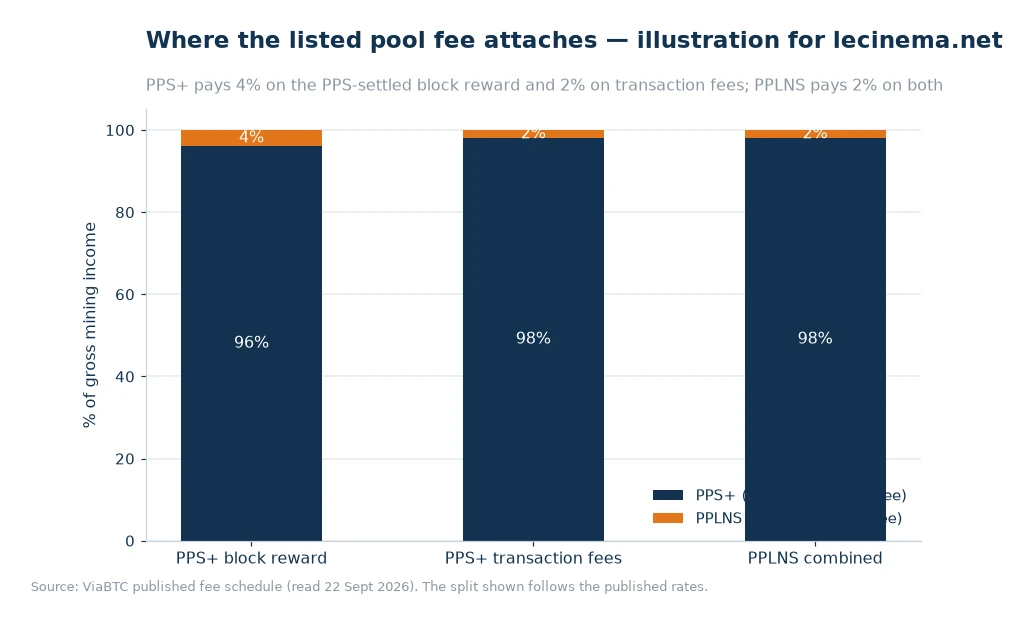
- Check the component: PPS+ charges a listed 4% on the PPS-settled block reward and 2% on transaction fees, while PPLNS charges a listed 2% on both together.
- Check the cadence: PPS+ pays hourly at current difficulty; PPLNS pays after 6 confirmations across the last 5 difficulty rounds.
- Check what risk stays with you. Pool luck and variance are priced into a lower rate rather than removed by it.
The denominator problem
A rate without output has no size. At difficulty 132.76 T, 100 TH/s earns 0.00004735 BTC a day, which is $4.04 at $85,294 per BTC, so a 4% charge on that block-reward component is about 16 cents a day. Run the same calculation at 10,000 TH/s and gross output is $403.89 a day, so the identical 4% is about $16.16 a day. Nothing about the rate changed; only the denominator did.
The second half of the problem is which component the rate is charged on. PPS+ applies a listed 4% to the PPS-settled block reward and a listed 2% to transaction fees, while PPLNS applies a listed 2% to the block reward and transaction fees together. Two arrangements both described as "2%" are therefore not the same claim: one is charged on a balance that includes variable transaction fees, the other only on the block subsidy, which is fixed at 3.125 BTC per block.
Normalizing three quotes
Put every quote through the same three questions — which components, what cadence, who carries the risk — and the numbers become comparable without any judgement about which vendor is better.
| What the quote says | The base it lands on | What it costs at 10,000 TH/s |
|---|---|---|
| 4% on the block reward (PPS+) | The PPS-settled block-reward component only | About $16.16 a day, near $484.67 over 30 days |
| 2% on both components (PPLNS) | Block reward and transaction fees together | About $8.08 a day, near $242.33 over 30 days |
| Hourly settlement | Current difficulty, 24 credits a day | Daily gross of $403.89 split into lines of about $16.83 |
| 6 confirmations over 5 rounds | The pool's blocks inside that window | At 1 PH/s an hourly credit is near $1.68; PPLNS credits bunch instead of arriving hourly |
| Mining payouts | Withdrawal side, listed as zero-fee | The net credit is what reaches the wallet, so no second charge is embedded in the statement |
Read the table downwards and a pattern appears: rows one and two answer what the fee is charged on, rows three and four answer when it arrives, and row five answers whether anything is taken again on the way out. A quote that answers only the first question is a headline, not a comparison.
A third denominator is time. A rate charged hourly against current difficulty and a rate settled after 6 confirmations across the last 5 difficulty rounds deliver the same long-run total from the same hashrate, but they deliver different monthly bills, and a fleet financed on a monthly power cycle feels that difference even when the annual sums match. When a schedule mentions settlement, it is describing the shape of your cash flow rather than the size of your cost.
Worked example
Normalize both arrangements at 1 PH/s. Gross output is 0.00047353 BTC a day, or $40.39 at $85,294. Charged at 4% on the block-reward component, the fee is 0.04 x $40.39 = $1.62 a day; charged at 2% on the same component it is $0.81 a day. Over 30 days that is $48.47 against $24.23, a difference of roughly $24 for the month. Net of the fee, the daily figures are $38.77 and $39.58.
Notice how small the two-point gap looks here and how large it looks at the other end of the scale. Ten thousand terahashes change the annual cost of that same gap from about $291 to roughly $2,908. The percentage is constant; the exposure is not. That is why large fleets negotiate on the base and small operators should compare on output, since at 100 TH/s the whole monthly fee at the higher listed rate is under $5.
At the small end the ranking of costs reverses. A 100 TH/s operator comparing rates is arguing over a couple of dollars a month, while an unplanned outage at 1 PH/s costs about $1.68 an hour in gross output and a stale worker configuration can quietly halve output for days. The practical order of work is therefore fixed for small fleets — get uptime and worker settings right, then revisit the rate once the gross line is stable and worth optimising.
What to ask before comparing two pools
Ask what the number on the ViaBTC Pool Fees schedule is charged on, and expect an answer in components rather than in a single figure: a listed 4% on the PPS-settled block reward and a listed 2% on transaction fees under PPS+, or a listed 2% on both together under PPLNS. Then ask when settlement occurs, because an hourly credit at current difficulty and a payment after 6 confirmations over the last 5 difficulty rounds are different products even when the percentages match.
Finally, check the exit side. Mining payouts listed as zero-fee mean the net credit is what arrives, so comparisons should stop at the net line rather than adding a withdrawal charge that does not exist here. Keep a statistics view open while you do it: your credited output per day divided by your hashrate is the only number that tells you what you actually paid, and it can be checked against the pool's own hashrate and difficulty in the same place.
Keep a written normalization for every pool you consider: the rate, the component it is charged on, the cadence, and the base. Four lines of text turn a shelf of percentages into a single comparison and make the arithmetic auditable when a quote changes, which is the moment comparisons usually go wrong. Without them, the only figure most buyers have to compare is the one printed largest on the page.
Frequently asked questions
Is a lower percentage always cheaper?
No. A lower rate charged on a broader base can cost more than a higher rate charged on one component, and the difference only becomes visible once both are applied to your own output in BTC or dollars.
Why does the same rate produce different bills for two miners?
Because the rate applies to output, and output scales with hashrate: the same two points of difference are about $2.42 a month at 100 TH/s and roughly $242.33 at 10,000 TH/s.
What single figure makes two fee quotes comparable?
Net daily output at your hashrate. Gross output at 100 TH/s is 0.00004735 BTC a day at current difficulty, so subtract each quoted rate from that and compare the remainders.
Compare remainders, not rates
Convert every quote into net BTC a day at your own hashrate, then convert that into dollars at the price you actually sell at, and only then compare. Note the difficulty in use, because a 1.90% adjustment moves per-terahash income by about 1.86% and rewrites the answer within a fortnight. Done that way, the comparison stops being about marketing and starts being about arithmetic you can defend.
Data and sources: the fee schedule listed by ViaBTC[1] and pool statistics documentation[2]. Readings behind the arithmetic: BTC difficulty 132.76 T, network hashrate 950.3 EH/s and a price of $85,294 per BTC, read 22 Sept 2026. Each figure quoted follows from those inputs and changes with difficulty and price; nothing on this page is a promise of earnings.