
From Hourly Payout to Spendable Balance
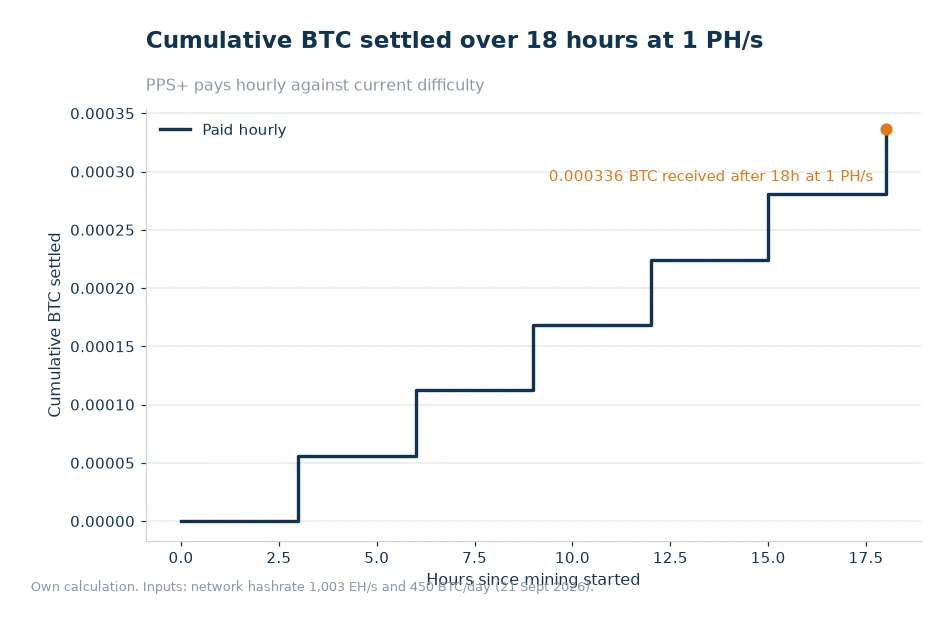
Eighteen hours covers an overnight run and most of a working day, which makes it a practical window for checking whether a payout pipeline works. At 1 PH/s the account credits 0.00001869 BTC an hour, reaching 0.00033645 BTC after 18 hours — $28.50 at $84,692 per BTC. Short windows like this expose timing problems that a monthly total hides, and they cost nothing to observe.

Key takeaways
- At 1 PH/s, 18 hours of PPS+ settlement credits 0.00033645 BTC, worth $28.50 at $84,692.
- Each hour adds 0.00001869 BTC, so the balance moves in steps of about $1.58.
- Zero-fee mining payouts mean the credited amount is the amount available to withdraw.
- A multi-currency wallet with Auto Conversion keeps the payout, the exchange and the exit in one account.
Eighteen hours is a working test
Most payout problems announce themselves within a day. A wrong address shows up as an empty balance; a machine that never connects shows up as a flat line; a settlement rule that was misunderstood shows up as a total that does not match the arithmetic. Eighteen hours is long enough for all three to appear and short enough that the diagnosis happens while the details are still fresh.
It is also a natural interval for anyone running hardware at home. Machines start in the evening and run through the night; by the following afternoon there is a full cycle of temperatures, fan behaviour and network conditions to look at. Matching the payout check to that cycle costs nothing and turns a vague sense that things are fine into a number.
The rate behind the steps
One petahash per second is 1,000 TH/s. At a network hashrate of 1,003 EH/s, each terahash earns 0.00000044865 BTC a day, so the petahash earns 0.00044861 BTC a day. Divide by 24 and the hourly credit is 0.00001869 BTC. Multiply by 18 and the total is 0.00033645 BTC. Every figure in the table below comes from that single chain of three operations.
PPS+ is what makes the steps hourly. The block-reward portion settles against current difficulty, and the transaction-fee portion follows a listed 2% under PPLNS logic. Because the reward side is the larger part of income on most days, the hourly step is dominated by the difficulty reading rather than by fee activity. PPLNS would replace the staircase with lumps tied to blocks reaching 6 confirmations, and an 18-hour window would be a poor sample for judging it.
That is not a criticism of PPLNS, only a note about sample size. The method is designed to be judged across many rounds, and a single evening says little about it. An operator who wants to compare the two properly should run each for a month and compare the totals rather than the shape of the balance at midnight. The shape tells you when money arrives; the total tells you what it was worth.
Four points on an 18-hour run
The table samples the run at three-hour intervals from the ninth hour onward. The dollar column uses $84,692 per BTC, and the share column shows how much of the full 18-hour total has arrived at each point.
| Hour | Cumulative BTC | USD at $84,692 | Share of 18-hour total |
|---|---|---|---|
| 3 | 0.00005608 | $4.75 | 16.7% |
| 9 | 0.00016823 | $14.25 | 50.0% |
| 15 | 0.00028038 | $23.74 | 83.3% |
| 18 | 0.00033645 | $28.50 | 100% |
The nine-hour row is exactly half the total, which is the simplest check available: if the balance at the midpoint is not close to half the expected 18-hour figure, something changed during the run. That something is usually a difficulty adjustment, a machine dropping offline, or a misunderstanding about which payment method is active. All three are easier to find at the midpoint than at the end.
Worked example
Build the 18-hour total from the chain inputs read on 21 Sept 2026.
- Daily BTC per TH/s: 450 ÷ 1,003,000,000 = 0.00000044865.
- 1 PH/s = 1,000 TH/s, so daily output is 0.00044861 BTC.
- Hourly credit: 0.00044861 ÷ 24 = 0.00001869 BTC.
- Three hours: 3 × 0.00001869 = 0.00005608 BTC, or $4.75.
- Nine hours: 9 × 0.00001869 = 0.00016823 BTC, or $14.25 — half the run.
- Fifteen hours: 15 × 0.00001869 = 0.00028038 BTC, or $23.74.
- Eighteen hours: 18 × 0.00001869 = 0.00033645 BTC, and 0.00033645 × 84,692 = $28.50.
Where the balance becomes spendable
The ViaBTC Crypto Wallet holds each listed coin as a separate balance inside the same account that reports hashrate. When a withdrawal is made, the amount leaves the mining balance and appears as a transfer; zero-fee mining payouts mean the credited figure is the figure that moves. There is no second deduction at the door, which is why an 18-hour test is a fair test of the whole path rather than of part of it.
Auto Conversion sits beside the balance. If income arrives in one coin and costs are paid in another, conversion happens inside the account rather than through an external exchange, and both legs of the trade appear in the same history. For a small balance the saving is not the spread; it is the absence of a separate withdrawal, a separate deposit and a separate set of fees to reconstruct later.
What a short window cannot show
Eighteen hours says nothing about variance under PPLNS, and very little about the effect of difficulty over a month. It also says nothing about hardware degradation, which shows up across weeks as a slow decline in effective hashrate rather than as a single missing credit. Those questions need a longer record: a daily note of hashrate, balance and difficulty for a month will answer them, and the effort is a few minutes a week.
The short window is still worth running, because it catches the failures that matter most: a misconfigured worker, a stale address, a coin selected by mistake. Those are binary problems, and they are visible immediately. Treat the 18-hour check as a smoke test and the monthly record as the audit, and the two together cover more ground than either alone. Add one rule to the routine: never change a payout address and leave the account unattended for a day, because the first credit after a change is the only proof that the change worked.
There is also a habit worth building around the clock. An 18-hour run crosses a night, and nights are when firmware updates, scheduled reboots and cooling failures tend to land. A hashrate alert at three in the morning is worth more than a perfect spreadsheet at nine, because it shortens the interval between a fault and a fix. The balance is the record of what happened; the alert is what limits the damage.
Frequently asked questions
Why does the balance move in small steps rather than continuously?
Because a ledger records settlement events, and PPS+ settles the block-reward component hourly, so the balance rises by about 0.00001869 BTC per hour at 1 PH/s and holds flat in between.
How much is 18 hours of mining worth at 1 PH/s?
0.00033645 BTC at a network hashrate of 1,003 EH/s, which is $28.50 at $84,692 per BTC, assuming the difficulty remains unchanged across the run.
Can I withdraw part of the balance?
Yes. Mining income can be withdrawn or converted in part, and because mining payouts are zero-fee the credited amount is what leaves the account when a transfer is made.
Keep the check short, the record long
Run the 18-hour check after any change: a new machine, a new address, a switch of payment method. Then keep a monthly line of hashrate, difficulty and dollars using the Profit Calculator for the dollar side. The short check catches mistakes, and the long record catches drift. Neither takes long, and together they replace most of the guesswork in a mining operation.
Sources: the ViaBTC wallet and fee pages for wallet features, Auto Conversion, zero-fee mining payouts and the listed 4%[1]. Chain data read 21 Sept 2026: network hashrate 1,003 EH/s, difficulty 132.76 T, 3.125 BTC per block, 144 blocks a day, BTC $84,692. Published 22 Oct 2026; figures are arithmetic on those inputs.