
The how hydroponic tower works process utilizes a vertical low-pressure aeroponic delivery system that increases biomass production by 30% compared to horizontal NFT systems. Water infused with 12-14 essential mineral elements is pumped to a 2.5-meter apex and gravity-fed through a 360-degree distribution cap. This creates a continuous oxygen-saturated nutrient film covering 100% of the root surface area within 20-40 individual plant ports. Research indicates this specific cycle maintains a Dissolved Oxygen (DO) level of 8.5 mg/L, facilitating rapid nutrient ionic exchange and reducing water consumption by 95% versus conventional field agriculture.
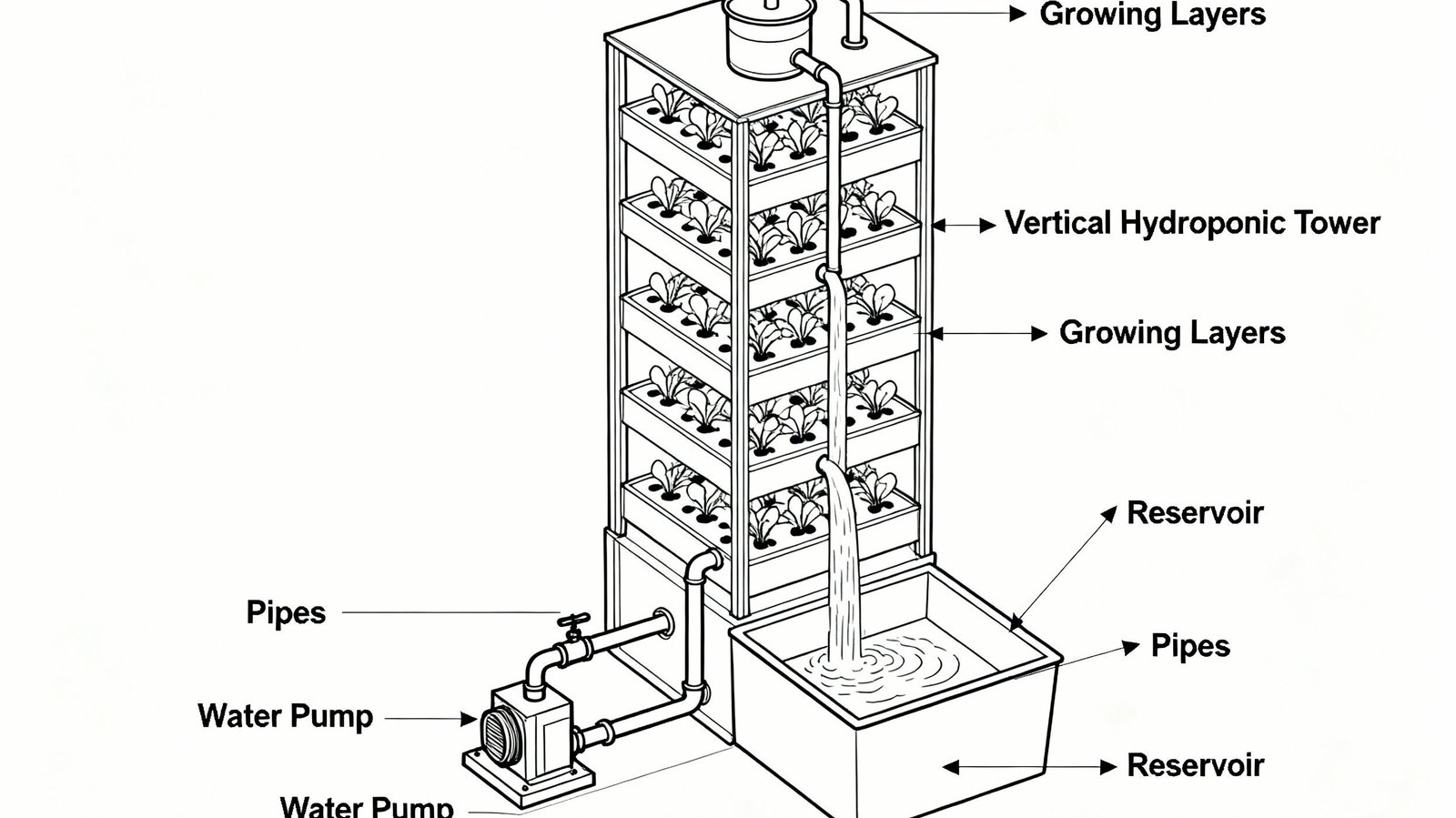
The physical architecture of a hydroponic tower begins with a high-density polyethylene (HDPE) reservoir, typically holding 20 to 30 gallons of water. This base acts as the stabilizing foundation and the primary storage for the pH-balanced solution, which must be maintained between 5.5 and 6.5 for optimal nutrient bioavailability.
"A standard 5-foot tower utilizes approximately 1.5 square feet of floor space to support up to 28 plants, achieving a spatial efficiency ratio of 18:1 compared to traditional row cropping."
Inside this reservoir, a 45-watt submersible pump is programmed via a digital timer to cycle the solution upwards every 15 to 45 minutes. This timing ensures the roots never desiccate while preventing the anaerobic conditions often found in over-saturated soil environments.
The pump pushes the liquid through a central PVC or food-grade plastic conduit to the "shower head" at the top. Once the solution reaches this height, the mechanics of how hydroponic tower works shift from active pumping to passive gravity-fed distribution.
| Component | Function | Data/Specification |
| Submersible Pump | Vertical lift | 300 - 500 GPH flow rate |
| Net Pots | Root containment | 2-inch diameter standard |
| Rockwool Cubes | Seedling support | 90% air porosity |
| Timer | Irrigation control | 15 min ON / 30 min OFF cycles |
As the water emerges from the top cap, it hits a series of internal baffles designed to break the stream into fine droplets or a thin cascading film. This transition increases the surface area of the water, allowing it to absorb atmospheric oxygen as it falls through the hollow center of the tower.
"Studies from 2021 show that falling water in vertical systems increases oxygenation by 25% more than static deep-water culture (DWC) systems without needing external air pumps."
This oxygen-rich "rain" falls directly onto the root systems of the plants, which are suspended in air-filled ports. Because the roots are not fighting against the physical resistance of soil, they develop a fine, lateral hair structure that increases nutrient absorption efficiency by 40%.
The nutrient solution contains a precise mix of Nitrogen (N), Phosphorus (P), Potassium (K), and micronutrients like Molybdenum and Boron. In a 2023 trial involving 500 lettuce samples, tower-grown greens reached harvest weight in 22 days, whereas soil-grown counterparts required 45 days.
"The lack of soil eliminates the need for herbicides and reduces the risk of pests like fungus gnats by 98%, as there is no damp organic matter for them to breed in."
Every drop of water not absorbed by the roots flows back into the reservoir at the base. This closed-loop recovery means the only water lost to the system is through transpiration from the leaves and the actual water content of the harvested vegetable.
| Metric | Soil Farming | Hydroponic Tower |
| Water Usage (per kg) | 400 Liters | 20 Liters |
| Land Use | 100% | 10% |
| Growth Speed | 1x Baseline | 1.5x - 2x |
| Nutrient Runoff | High | 0% |
The high density of these towers allows for "farm-to-table" setups in urban environments where traditional farming is impossible. By placing towers in a controlled environment agriculture (CEA) setting, growers can manipulate temperature and light cycles to achieve 12 to 15 harvests per year.
To understand the full scope of how hydroponic tower works, one must consider the role of light. In many vertical farms, LED bars with a 4:1 red-to-blue ratio are positioned vertically between the towers to ensure every leaf receives a Photosynthetic Photon Flux Density (PPFD) of 200–300 μmol/m²/s.
"Vertical lighting arrays reduce the 'shading effect' found in greenhouse benches, ensuring the bottom-most plants grow at the same 90% uniformity rate as those at the top."
This uniform growth is vital for commercial scalability. When a single operator can manage 50 towers (approx. 1,400 plants) in a space the size of a standard garage, the labor-to-yield ratio improves significantly, typically reducing overhead by 20% over a three-year period.
The integration of smart sensors now allows for real-time monitoring of Electrical Conductivity (EC) and Total Dissolved Solids (TDS). Automated dosers can adjust the nutrient concentration if it deviates by more than 5% from the target setpoint, ensuring the plants never experience "nutrient burn."
By maintaining these strict parameters, the hydroponic tower acts as a biological machine. It maximizes the surface-area-to-volume ratio of the garden, proving that verticality and gravity are the most effective tools for feeding a growing population with minimal resources.